

Celebrating its 75th year and widely considered as the most prestigious historic vehicle event in the world, if not the pinnacle of Concours d’Elegance events, FIVA and the Pebble Beach Concours share a strong history together.
With this year’s edition of the Pebble Beach Concours, FIVA’s presence took on a more amplified form, as part of the Pebble Beach Classic Car Forum discussion held on the 14th of August. Titled “FIVA & the Pebble Beach Concours d’Elegance - Celebrating Living History in Automobiles”, moderated by Donald Osborne, FIVA Representative for North America and attended by FIVA President Alberto Scuro, the celebrated panel members, Jay Leno, Wayne Carini and Paul Russel, explored a broad range of issues ranging from originality and preservation to the responsibility of caring for automobiles as an important part of our cultural heritage.
Most notably, the fact that this forum took place together with the 75th gathering of the Pebble Beach Concours d’Elegance and the 60th Anniversary of FIVA served to highlight how the alignment between FIVA and the Pebble Beach Concours d’Elegance has led to a sea change approach to the collection of vehicles around the world and their implications for the future of the historic vehicle world.
Of these shifts, is the growing attention to ‘preserved vehicles’ versus ‘restored vehicles’. FIVA has long championed the need for preservation and authenticity as encapsulated in the seminal FIVA ‘Charter of Turin’ which also recognizes historic vehicles as cultural artefacts.
Accordingly, it should then be of no surprise that FIVA and the Pebble Beach Concours together launched the FIVA Best Preserved Award in 1999, with the objective to help ensure that the stewardship of unrestored vehicles is widely celebrated and strongly encouraged. However, it would seem that the impact of this award has had far reaching effects as exemplified by the fact that a ‘Preservation Class’ Bugatti was selected as the Best of Show winner in the 2024 edition of the Pebble Beach Concours, not to mention similar awards received by other cars in preserved condition in numerous other events across the globe.
For the 2026 FIVA Preservation Awards, two judging groups were formed. For the Pre-War FIVA Trophy, FIVA co-Representative for the United States, Mark Gessler led the judging, joined by Fred Johansson. The Post-War FIVA Trophy was judged by a team comprising of Massimo Delbo, Tom Meadows, Rick Mikulski and Gary Schroeder. The FIVA team leader was Adolfo Orsi who has served as the Chief Judge of the FIVA Awards at the Pebble Beach Concours since their inception in 1999.
The pre-war class was filled with numerous very well preserved cars, all very close in final judging. Mark Gessler identified a number of contrasts between the cars, and observed how vehicles can age differently based on the quality of the materials used on them and other surrounding factors. By way of example, Gessler pointed out the state of preservation of the exterior paint of two cars of nearly the same age, namely a 1915 Packard Twin-Six 1-35 and a 1916 Crane-Simplex. During the period of the manufacture of these vehicles, it was common practice to apply coats of varnish (often annually as prescribed) to keep finishes attractive. Yet, following the passing of over 110 years, the Packard exhibited a more bubbled finish while, by contrast, the Crane-Simplex had maintained a smooth surface. According to Gessler, the difference likely arises from the number of applications of varnish, thickness of the application, temperature effects and the specific chemical properties of the products used.
Following a very close competition for the pre-war class, a 1930 Cord L-29 Murphy Town Car owned by Dano Davis of Jacksonville, Florida was awarded the FIVA Pre-war trophy and also took class victory. According to Gessler, “while the judging was close, this car (a former Hollywood star car) was the best of the best.”

For the FIVA post-war class trophy, judging was just as tight with all the class participants very closely matched. As with the pre-war class cars, Gessler again noted the challenges judges face, such as detecting if a number of factors, in particular paint finishes, are original factory or expertly restored with only a brief visual inspection.
In the FIVA trophy class, a bonus is offered for well documented histories. However, an added plus, is the ability to receive first-hand accounts from original owners. Whilst, this may not be possible in the pre-war class, in the post-war class at times the opportunity arises. This was indeed the case for the winning 1963 Jaguar E-Type Fixed Head Coupe owned by Buzz and Julia Lynn of Reno, Nevada. As members of the original family owners, they were able to complement the documentation of their Jaguar with first–hand accounts of the Jaguar’s entire history, including minor damage and repairs. In sum, the combination of the preserved state of the car, its documentation and the first hand family testimonials about the car led to the Jaguar being selected as the winner of the FIVA Post-War Class Trophy.
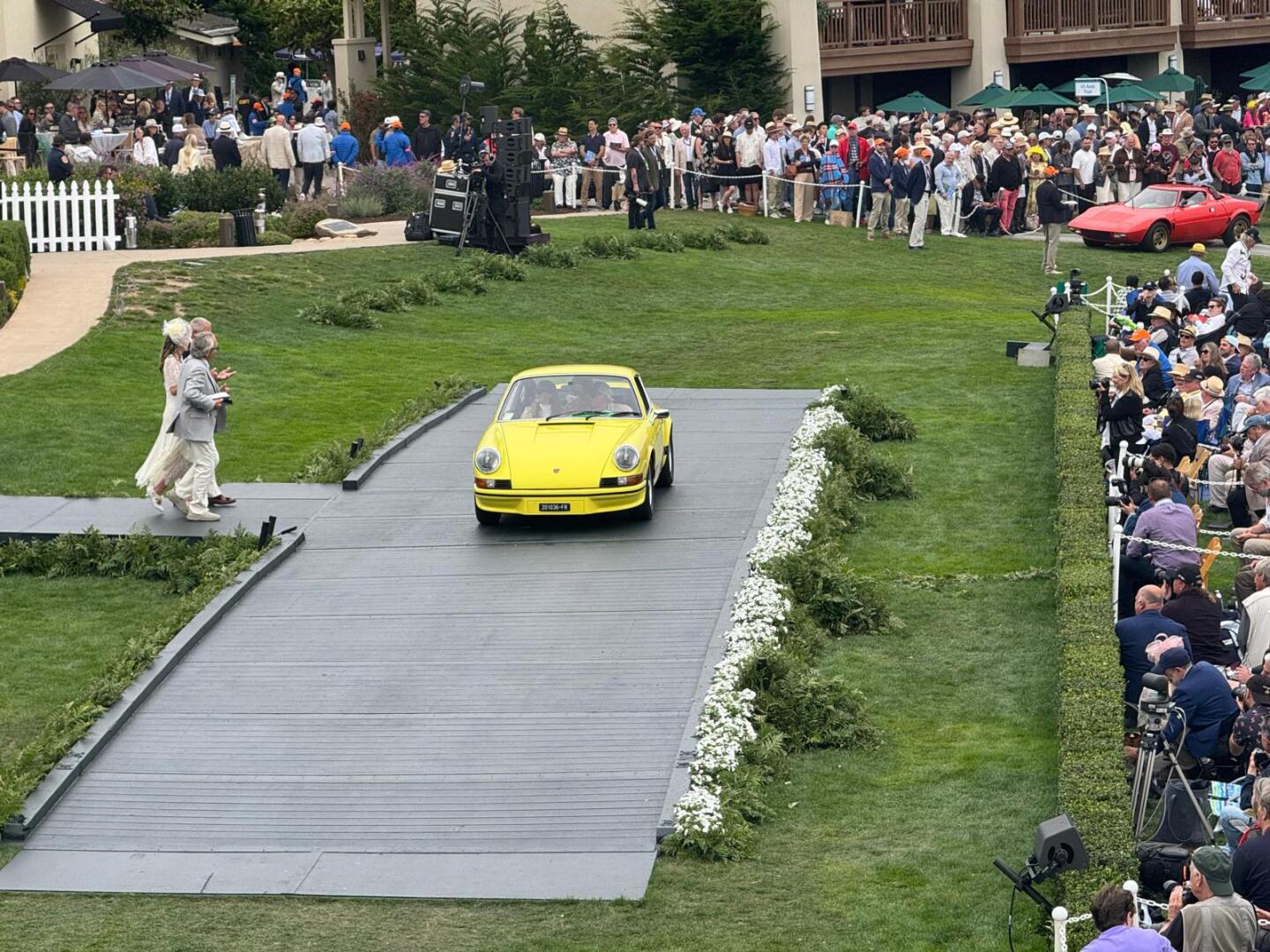
Gessler also pointed out that while all the cars on display were truly unique and special, he drew attention to two cars that particularly stood out for their preserved state. The first was a 1973 Porsche 911 Carrera RS 2.7 “M471 Lightweight”, one of just 200 built which the original owner had even preserved its original factory delivery seat covers and was exceptionally well documented. The Porsche also received a FIVA ID Card which was handed over by FIVA President Alberto Scuro. The other was a 1974 Lancia Stratos HF Stradale Coupe. One of 492 produced, this example is recognized as one of the most original surviving cars. Finished in its original factory Rosso Arancio over Havana Alcantara, the Stratos still even retains its original trim and factory details throughout.
According to Gessler, “25 years ago when the preservation trophy was established, the intent was to ensure excellent examples of original craftsmanship and production methods in a way to encourage their continued conservation. By that time, the old adage was that the best candidate for restoration was the most preserved car …. as it would have all the correct bits and parts to make a “perfect restoration”. As we all know, ‘perfection’, particularly in the United States, and as well exemplified in the Pebble Beach Concours, often led to restored vehicles that were better than they were in when they left the factory or the coachbuilder. Better than new was where the pendulum swung. As a consequence, the well preserved examples became ever rarer. This was how the trophy was born”.
Over the years, and especially in the last 15 years, Gessler points out that through the valuable work of the FIVA Technical Commission and the former FIVA ANF in the United States, the Historic Vehicle Association (HVA), and subsequently the Hagerty Drivers Foundation, the standards for judging were established and FIVA trophies were presented in much the same manner as numerous other Concours events across the world. The role, support and backing of the Hagerty Drivers Foundation is intrinsic to the success of this class.
Looking back, Gessler points out that today, the historic vehicle community has undergone a major transformation in what owner’s prize, namely originality (especially for paint, interior and the like), documentation and use (mileage). According to Gessler, “the pendulum is now swinging in the other direction!”
Gessler also points out that the ‘preservation’ trend is also now becoming more prevalent among relatively younger cars, especially among low mileage, 1980-2000’s cars. He draws attention to the fact that both Ferrari and Porsche collectors increasingly seek original and preserved vehicles, also pointing out that Corvette owners have long had their own standards for originality and preservation via the Bloomington “Zenith” awards.
FIVA also extends its congratulations to the 2026 Pebble Best of Show winner, the former Clark Gable Duesenberg SSJ owned by Harry Yeaggy of Cincinnati, Ohio. One of two Special Speedster examples built in 1935, Concours Chairwoman Sandra Button pointed out that the Duesenberg offered not only style and performance, but also a unique backstory.
A total of 218 cars, including 33 entries from outside of the United States (from 14 countries) were displayed at this year’s Concours. A total of $4.3 million was raised for charity. Next year’s Pebble Beach Concours d’Elegance will take place on the 15th of August.